Institutional Insights: Credit Agricole FX Weekly 24/7/26

The next FX weekly report is set to published September 4th.
---
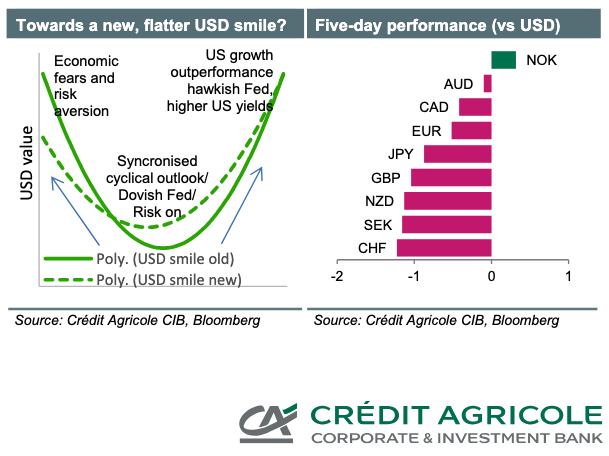
A noteworthy trend has emerged in the USD landscape: foreign investors are significantly changing how they finance the US current account deficit. Recent TIC data reveals that over 80% of foreign capital inflows in the past year have funneled into risk-related USD assets, leaving a mere 19% for safe-haven U.S. Treasuries. This shift in the balance between risk-oriented and safe-haven US assets could profoundly influence the USD's performance during periods of heightened risk appetite or increased risk aversion.
---
To understand this dynamic, let's explore the concept of the ‘USD smile.’ This theory suggests that the USD tends to shine during times of risk aversion and when US interest rates rise. However, as foreign investments increasingly gravitate towards riskier assets, the USD's allure as a safe haven might diminish during spikes in market anxiety—whether from geopolitical tensions or a downturn in tech stocks. Consequently, we might see a flattening of the ‘USD smile,’ which could be less flattering for the dollar as investors seek safer alternatives, such as gold (XAU).
---
As we approach the July Federal Reserve meeting, the outlook for the USD will hinge on another crucial element of this ‘smile’—the trajectory of US interest rates. The Fed is anticipated to maintain its current rates next week, making its forward guidance a key driver in the FX market. Additionally, all eyes will be on the preliminary Q2 GDP figures and June's core PCE data. We believe that the market's expectation of two further rate hikes in the near future is overly optimistic and that insights from Fed officials and US economic data may challenge this view, providing minimal support for the USD in the short term.
---
Looking ahead, next week will also spotlight the policy meetings of both the Bank of England (BoE) and the Bank of Japan (BoJ). Starting with the BoE, we expect the Monetary Policy Committee to keep interest rates steady while maintaining a neutral stance that might leave overly aggressive UK rate investors disappointed. Market participants will be keenly watching for any hints regarding the UK’s fiscal outlook to adjust their strategies accordingly. Meanwhile, the BoJ is likely to hold its rates steady as well, with Governor Kazuo Ueda potentially delivering a dovish press conference that could deflate the overly hawkish expectations surrounding the Japanese yen (JPY).
Disclaimer: The material provided is for information purposes only and should not be considered as investment advice. The views, information, or opinions expressed in the text belong solely to the author, and not to the author’s employer, organization, committee or other group or individual or company.
Past performance is not indicative of future results.
High Risk Warning: CFDs are complex instruments and come with a high risk of losing money rapidly due to leverage. 68% and 74% of retail investor accounts lose money when trading CFDs with Tickmill UK Ltd and Tickmill Europe Ltd respectively. You should consider whether you understand how CFDs work and whether you can afford to take the high risk of losing your money.
Futures and Options: Trading futures and options on margin carries a high degree of risk and may result in losses exceeding your initial investment. These products are not suitable for all investors. Ensure you fully understand the risks and take appropriate care to manage your risk.
Patrick has been involved in the financial markets for well over a decade as a self-educated professional trader and money manager. Flitting between the roles of market commentator, analyst and mentor, Patrick has improved the technical skills and psychological stance of literally hundreds of traders – coaching them to become savvy market operators!