S&P500 Daily Action Areas & Price Targets 29/7/26
S&P500 Daily Action Areas & Price Targets 29/7/26
***QUOTING ES1! FOR CASH US500 EQUIVALENT LEVELS, SUBTRACT POINT DIFFERENCE***
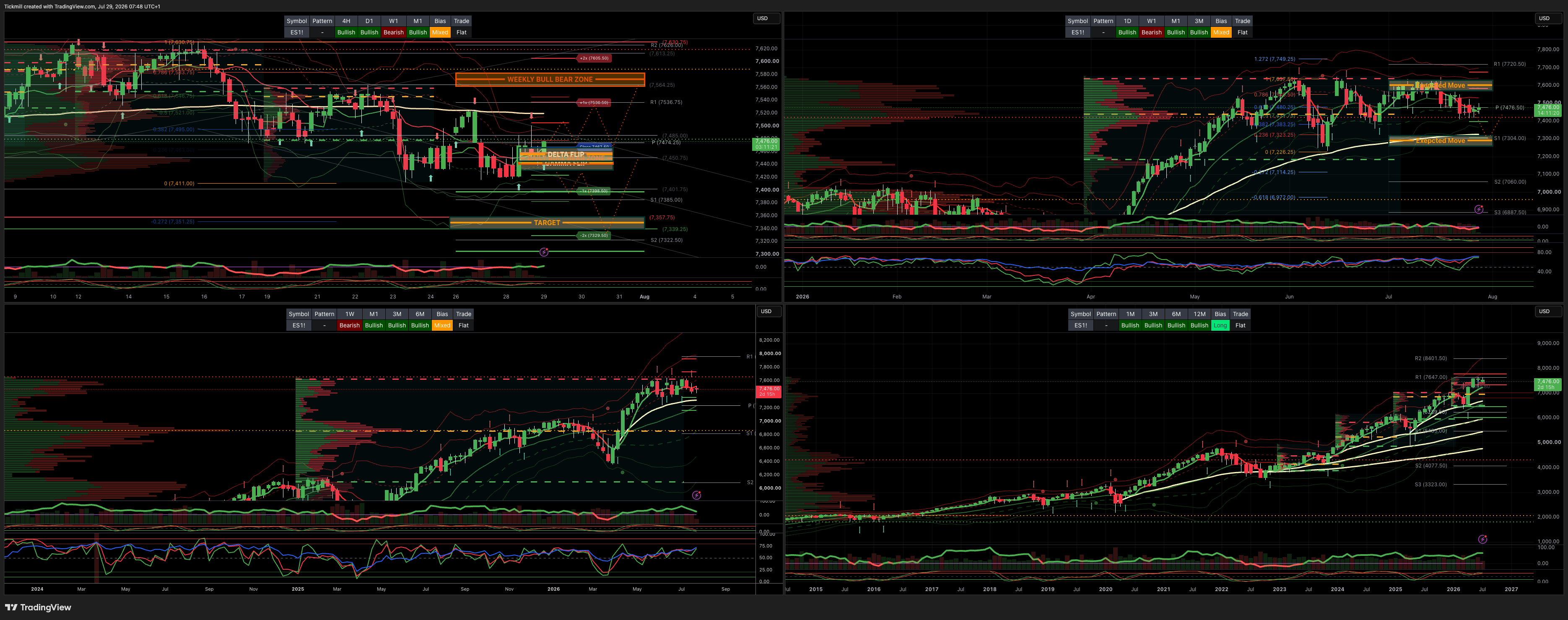
WEEKLY BULL BEAR ZONE 7560/80
WEEKLY RANGE RES 7602 SUP 7301
MONTHLY RANGE RES 7838 SUP 7258
JHEQX Q3 Collar Short Call Cap: ~7,750 – 7,900 - Long Put Strike: ~7,050 – 7,100 (approx. 5% downside protection) Short Put Strike: ~5,950
DEC2025 OPEX to DEC2026 OPEX is 945 points giving us a range of [5889,7779]
SPX PUT/CALL RATIO 1.13 (The numbers reflect options traded during the current session.) A put-call ratio below 0.7 is generally considered bullish, and a put-call ratio above 1.0 is generally considered bearish.
GS Flow Desk: large S&P 31Aug 7000/7950 strangle in roughly $20mm vega / $115mm premium …My Read – classic “big convexity versus carry” trade: either someone paid a lot to own a wide August move, or someone got paid a lot to bet that the S&P stays comfortably inside the 7000–7950 corridor
DAILY VWAP BULLISH 7453
WEEKLY VWAP BEARISH 7522
MONTHLY VWAP BULLISH 7036
DAILY STRUCTURE - BALANCE - 7411/7514
WEEKLY STRUCTURE - BALANCE 7648/7247
MONTHLY STRUCTURE - OTFH - 7247
Balance: This refers to a market condition where prices move within a defined range, reflecting uncertainty as participants await further market-generated information. Our approach to balance includes favouring fade trades at the range extremes (highs/lows) while preparing for potential breakout scenarios if the balance shifts.
One-Time Framing Higher (OTFH): This represents a market trend where each successive bar forms a higher low, signalling a strong and consistent upward movement.
One-Time Framing Lower (OTFL): This describes a market trend where each successive bar forms a lower high, indicating a pronounced and steady downward movement.
DAILY BULL BEAR ZONE 7458/48
GAMMA FLIP 7442
DELTA FLIP 7456
DAILY RANGE RES 7536 SUP 7398
2 SIGMA RES 7605 SUP 7329
VIX BULL BEAR ZONE 17.9
(VVIX / VIX):5.41
TRADES & TARGETS
LONG ON ACCEPTANCE ABOVE DAILY BEAR ZONE TARGET DAILY RANGE RES
***ADDITIONAL SETUPS & TARGETS HIGHLIGHTED ON THE CHARTS***
(I FADE TESTS OF 2 SIGMA LEVELS ESPECIALLY INTO THE FINAL HOUR OF THE NY CASH SESSION AS 90% OF THE TIME WHEN TESTED THE MARKET WILL CLOSE ABOVE OR BELOW THESE LEVELS)
GOLDMAN SACHS FICC & EQUITY TRADING DESK VIEWS
Goldman July FOMC Take — Hold, but Not Relief
Goldman’s cross-asset take is that the July FOMC is unusually uncertain, but the base case remains a hold. The key nuance is that a hold may not be a clean risk-positive event. Markets have priced a meaningful probability of a hike, oil has reintroduced inflation risk, Fed communication risk is elevated, and the broader equity narrative is still dominated by AI earnings and the Iran / oil outlook.
The meeting is therefore less about the binary decision itself and more about whether the Fed can avoid creating a policy-error narrative.
The central tension:
Soft June CPI / PPI argues for no action.
Oil near stressed levels / geopolitical conflict argues for inflation vigilance.
Fed split / Warsh uncertainty increases event risk.
Market pricing of roughly 8–10bps of hikes means either outcome creates a “surprise.”
No SEP meeting makes a surprise hike harder to justify.
A hawkish hold may still leave markets worried about September.
1. GS Economics: Base Case Is No Hike
Goldman Economics expects the FOMC to leave the fed funds rate unchanged at the July meeting. The statement may acknowledge upside inflation risks from renewed geopolitical conflict, and there will likely be at least one dissent in favor of a hike.
However, most voters are unlikely to support a hike for three reasons:
June inflation data softened.
The Fed historically avoids surprise hikes.
This is not an SEP meeting, making a surprise policy change less likely.
The uncertainty is still unusually high because:
The FOMC has been split recently.
Chairman Warsh’s position remains unclear.
Some Iran re-escalation occurred during the blackout period.
Markets have repriced the chance of a July hike sharply higher.
Goldman’s economists still think the combined inflation impact from tariffs, war, and AI-related effects should diminish in coming months. That should leave core inflation soft enough for the Fed to remain on hold through year-end.
But they stress there is little margin for error. Continued conflict could influence the rate-hike debate more than the direct oil passthrough math would imply because it reinforces the idea that supply shocks are unpredictable and can return after markets assume they are over.
2. Fed Reaction Function: Supply Shocks Are the Problem
Goldman is skeptical that modest rate hikes would materially offset inflation from supply shocks. A 25bp hike does not produce more oil or resolve geopolitical supply disruptions.
That said, Fed officials may still feel pressure to respond if inflation does not improve. The issue is not only economic transmission; it is credibility. If inflation remains elevated, some officials may worry that not hiking creates the public perception that the Fed accepts high inflation.
So the Fed faces a difficult balance:
Choice | Risk |
|---|---|
Hike | Surprise tightening, equity risk-off, policy overreaction to supply shock |
Hold dovishly | Market prices Fed behind the curve |
Hold hawkishly | September hike risk rises, relief limited |
Hold with poor explanation | Belly / long-end risk premium rises |
This is why the event is asymmetric for risk assets. A hold is expected, but it does not automatically remove the macro overhang.
3. Rates Desk: July Pricing Is More About Positioning and FOMO Than True Hike Conviction
The rates desk notes that July meeting pricing cheapened from a low of 2.5bps to a peak of 9.5bps priced. While some commentators have pushed the surprise-hike argument, GS attributes the move more to:
Offsides positioning
Crowded 2x July vs 1x September trades after CPI
Hedge fund FOMO
Self-referential market dynamics
Perceived asymmetry if July pricing approaches 12bps
Hawkish Fed speak has mattered. Logan and Hammack suggest at least two regional presidents may vote for a hike, with Kashkari potentially joining given his May dissent. But the key point is that the Board likely remains more dovish than the regional presidents. If the Board does not vote to hike, the hawks probably do not have the numbers.
Goldman places weight on Waller’s speeches, especially his framework that a hot CPI reading would necessitate a hike. Since June inflation was soft, the desk takes Waller at his word: no hot CPI, no hike.
Preferred Rates Trades
The rates desk sees limited asymmetry in front-end shorts after the repricing. Instead, they prefer second-order receivers:
Receive SFRZ6/Z7
Receive 2y2y rate
Their view is that even if the Fed hikes, the 2y2y could rally if the hike is interpreted as reducing future inflation risk or limiting the need for a larger hiking cycle.
4. Inflation Desk: TIPS / Breakevens Look Cheap
The inflation desk argues that real rates have been the main driver of the Treasury selloff, not breakevens. Breakevens have widened only modestly since the June FOMC, while real yields — especially in the belly — are back near cycle highs. The 30-year point is effectively at all-time cheap levels.
The setup:
Hawkish FOMC repricing pressured rates.
War / oil dynamics increased inflation uncertainty.
Higher inflation risk fed expectations of a hawkish policy response.
Real rates rose sharply as financial conditions tightened.
Goldman does not expect a policy adjustment at the July meeting, and a hold should give TIPS / breakevens some reprieve. Given valuations, the desk sees asymmetry to being long TIPS / breakevens from current levels.
5. FX: Own USD Upside, Especially USDJPY Calls
FX gap pricing around the FOMC has risen with rates. The meeting is now pricing roughly a 50bp gap, but ex-event FX vols have continued to sell off into quiet summer markets. That leaves front-end FX vols near multi-year lows despite unusually uncertain rates pricing.
The FX options desk likes owning the USD call side of the distribution, especially in USDJPY. The interesting anomaly is that USDJPY skew still trades for USD puts, while most other G10 pairs trade for USD calls.
The suggested expression:
Buy 2m USDJPY 167 calls at 6.75 vol
Spot reference: 163.75
The rationale:
Spot is near multi-decade highs.
Every break through a new big figure this year has triggered a vol bid.
Topside strikes remain flat or discounted to ATM vol.
Energy / rates dynamics should cushion the dollar even if the Fed holds.
FX research expects any tactical dollar weakness on a hold to be short-lived because elevated energy prices should limit the shift lower in cumulative hike pricing. Over the medium term, a Fed on hold through year-end is a modest but manageable headwind for the dollar versus G10 peers.
6. Equities: Fed Risk Matters, but AI and Oil Matter More
The equity desk expects a hold, but because the market is pricing roughly 8bps of hikes into the meeting, either a hike or a hold creates a surprise relative to pricing.
However, the Fed may not be the dominant equity catalyst this week. The two bigger market themes are:
AI / hyperscaler earnings
Iran / oil outlook
If the Fed hikes, equities likely sell off as markets pull forward hike pricing. But communication matters. A hold with limited explanation could also be problematic if it reintroduces risk premium into the belly and long end of the curve.
The equity macro team also highlights that implied vol on US 30-year yields is near 15-year lows, making long-end payers an interesting hedge against term-premium concerns, despite the recent move higher in yields.
7. Index Derivatives: IWM Puts as Hike Hedge
The index derivatives desk notes that equities have become choppier as markets digest:
Momentum unwind
Earnings
Iran headlines
Oil shock
Treasury yield repricing
Rates markets have repriced the odds of a hike from nearly zero to around 35% over the past week. Short-dated skew has become meaningfully bid, especially in the Russell, which has been outperforming SPX and NDX YTD but is at risk of a sharper pullback if the Fed hikes.
Preferred hedge:
Buy IWM 31Jul or 7Aug puts
Rationale:
Russell should regain beta to rates after end-June rebalance.
Small caps are more vulnerable to higher financing costs.
Short-dated skew is bid but still directly expresses hike risk.
Dealer gamma is now mostly to the topside around the 50-day moving average, which could exacerbate downside moves.
8. Credit: Shorts Still Screen Well
Credit has remained relatively benign at the index level, but the underlying picture is deteriorating.
Key concerns:
Large widening in IG hyperscaler bonds, especially long end.
Spread weakness bleeding into the broader AI / data center exposed IG/HY complex.
Renewed Middle East geopolitical risk.
More hawkish yield repricing.
Reduced appetite for incremental risk.
Credit spreads remain near historical tights at the index level, while the cost of capital is resetting higher. Goldman argues that holding credit shorts still screens attractively, especially absent clarity on primary market supply and forward funding needs.
That said, positioning has already adjusted bearishly, and the slow drift wider has allowed real money and CTA accounts to pause and reset. For now, wider levels are still supported by soft CPI / PPI and solid corporate earnings.
9. Commodities: Oil Risk Premium Is Eroding, but Tail Risk Remains
The crude desk notes that oil risk premium is rapidly eroding, with crude down US$9 on the day as the US and Iran reached a de facto ceasefire and talks advanced to reopen the Strait of Hormuz.
Other supply risks have also eased:
CPC export terminal restarted.
Kazakhstan resumed production.
Red Sea looked calmer after attacks near Saudi’s Yanbu route.
The market expects proxy attacks to stop as diplomacy advances.
If Hormuz reopens or the blockade risk fades, crude has more room to come off because flat price, spreads, physical differentials, vol, and skew are still pricing stressed levels that require an actual blockade to be sustained.
However, upside risk remains material. Iranian proxies narrowly missed critical Saudi export infrastructure, and if attacks continue against Saudi production or export facilities, the market cannot digest the loss of rerouted barrels. In that case, crude could revisit April highs.
Preferred expression:
Tight crude put spreads
This expresses the bearish central scenario in max-loss format while limiting exposure to high vol and preserving protection against upside geopolitical risk.
10. Gold: Still Range-Bound, Long-Term Bullish, Tactical Around Events
Gold has traded in a roughly US$250 range over the last two months. It has recently decorrelated from oil and is trading more as a risk-off hedge.
China demand remains supportive:
Gold imports remain strong.
YTD buying boosted imports to 5.6mn oz.
Onshore ETF holdings declined from 9.8mn oz in March to 8.8mn oz, but outflows have stabilized.
Central banks continue buying:
GIR nowcast estimates 81 tonnes of purchases in May.
This is above the GIR 2026 forecast pace of 50 tonnes/month.
The metals desk remains bullish longer term but cautious tactically, preferring to trade around news events rather than chase within the range.
Cross-Asset Trade Map
Asset Class | Desk View | Preferred Expression |
|---|---|---|
Fed / Rates | Hold likely; September risk remains | Receive SFRZ6/Z7, receive 2y2y |
Inflation | TIPS / breakevens cheap | Long TIPS / breakevens |
FX | USD downside on hold likely short-lived | Buy 2m USDJPY 167 calls |
Equities | Fed matters, but AI / oil dominate | IWM puts as hike hedge |
Credit | Spreads vulnerable from tights | Credit shorts still attractive |
Crude | Risk premium eroding, tail risk remains | Tight crude put spreads |
Gold | Long-term bullish, tactical range | Trade around events; buy weakness selectively |
Key Event Risks
Hawkish Shock
A hike would likely:
Pull forward hike pricing.
Pressure equities.
Hit Russell / cyclicals.
Support USD.
Push real rates higher initially.
Widen credit spreads.
Pressure gold tactically.
Risk a vol impulse.
Hawkish Hold
Most likely outcome.
A hawkish hold would likely:
Keep September hike risk alive.
Limit equity relief.
Cushion the dollar.
Keep front-end rates vol elevated.
Leave gold range-bound.
Keep pressure on long-duration tech.
Force markets to focus on next CPI / oil.
Dovish Hold
Less likely.
A dovish hold would likely:
Weaken USD tactically.
Support equities near term.
Lower front-end yields.
Help gold and duration.
But could be faded if oil remains elevated.
Poorly Explained Hold
Potentially the most destabilizing hold variant.
A hold without adequate explanation could:
Reintroduce term-premium risk.
Pressure belly / long-end rates.
Leave the Fed appearing behind the curve.
Hurt equities despite no hike.
Support long-end payers.
Disclaimer: The material provided is for information purposes only and should not be considered as investment advice. The views, information, or opinions expressed in the text belong solely to the author, and not to the author’s employer, organization, committee or other group or individual or company.
Past performance is not indicative of future results.
High Risk Warning: CFDs are complex instruments and come with a high risk of losing money rapidly due to leverage. 68% and 74% of retail investor accounts lose money when trading CFDs with Tickmill UK Ltd and Tickmill Europe Ltd respectively. You should consider whether you understand how CFDs work and whether you can afford to take the high risk of losing your money.
Futures and Options: Trading futures and options on margin carries a high degree of risk and may result in losses exceeding your initial investment. These products are not suitable for all investors. Ensure you fully understand the risks and take appropriate care to manage your risk.
Patrick has been involved in the financial markets for well over a decade as a self-educated professional trader and money manager. Flitting between the roles of market commentator, analyst and mentor, Patrick has improved the technical skills and psychological stance of literally hundreds of traders – coaching them to become savvy market operators!